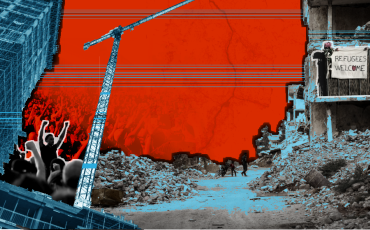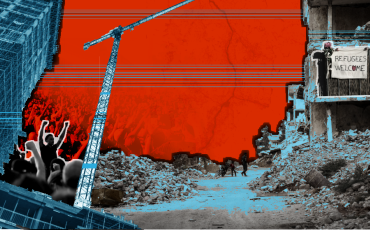
The CDU’s Misguided Push for Syrian Returns to Destruction: CDU leaders cite German history as a moral compass, ignoring that Syria is neither safe nor rebuilt. From Berlin, patriotism becomes a political abstraction with real human cost.
When the German chancellor Friedrich Merz recently declared that Germany had a problem in the cityscape (German: Stadtbild), and that’s why the Interior Minister is now enabling large-scale returns, it sparked a fuse across the country. His remarks were met with protests, petitions and accusations of scapegoating.
Barely weeks after, Merz raised the stakes further: “The civil war in Syria is over. There are now no longer any grounds for asylum in Germany,” he announced, positioning Syrians, many of whom have built lives in Germany, as candidates for forced return.
Yet even within Merz’s own Christian Democratic Union (CDU) cracks appeared. His foreign minister, Johann Wadephul, after a visit to the Syrian suburb of Harasta, speaks of flattened neighbourhoods, mined streets, and the absence of functioning administration: “It is barely possible for people to live here in dignity. Large-scale returns are only possible to a very limited extent.”
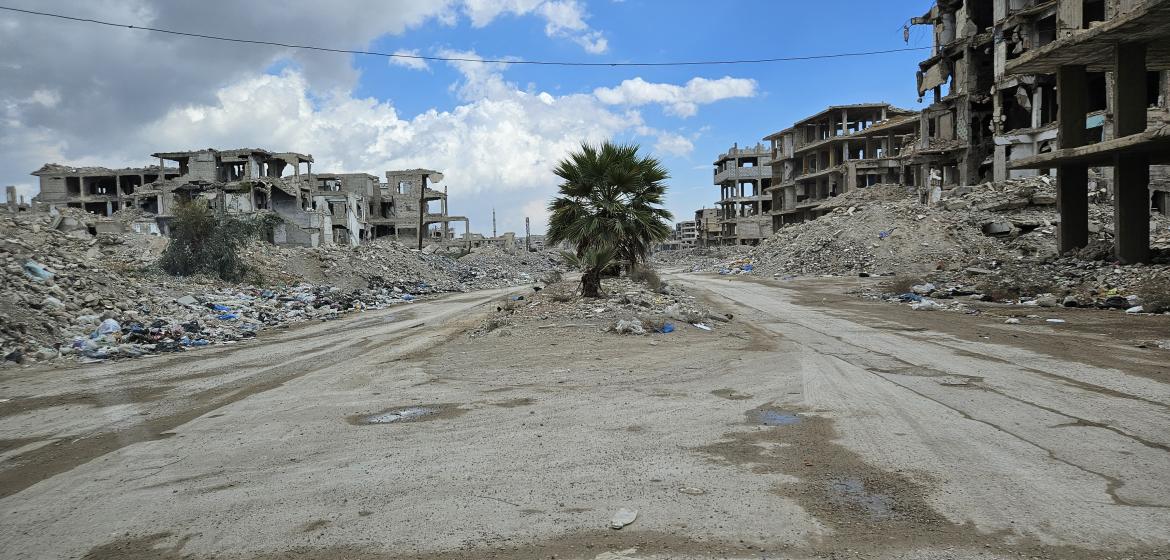
Syria remains a landscape of destruction
While I am in Damascus, surrounded by the ruins that prove Wadephul right, the debate has been unfolding. Merz quietly invited Ahmed al‑Sharaa, Syria’s interim president, to Berlin to negotiate a deportation agreement, signalling that the commitment to the principle of non-refoulement and basic human rights is being overwritten. The message is clear: Germany is shifting from “we welcome you” to “you must go back” and is doing so before the conditions for safe return exist. Not a strategy rooted in humanitarian principles or facts on the ground, but a political theatre aimed at domestic audiences anxious about migration.
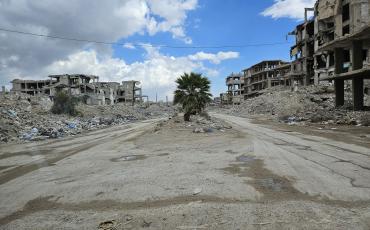
Despite the formal end of the Assad era, Syria remains a landscape of destruction. Entire districts lie in rubble. The ruins are visible on my way from the heart of Aleppo to Damascus. My journey ended in Yarmouk, where I was born and raised, a place where my own history now lies buried under dust.
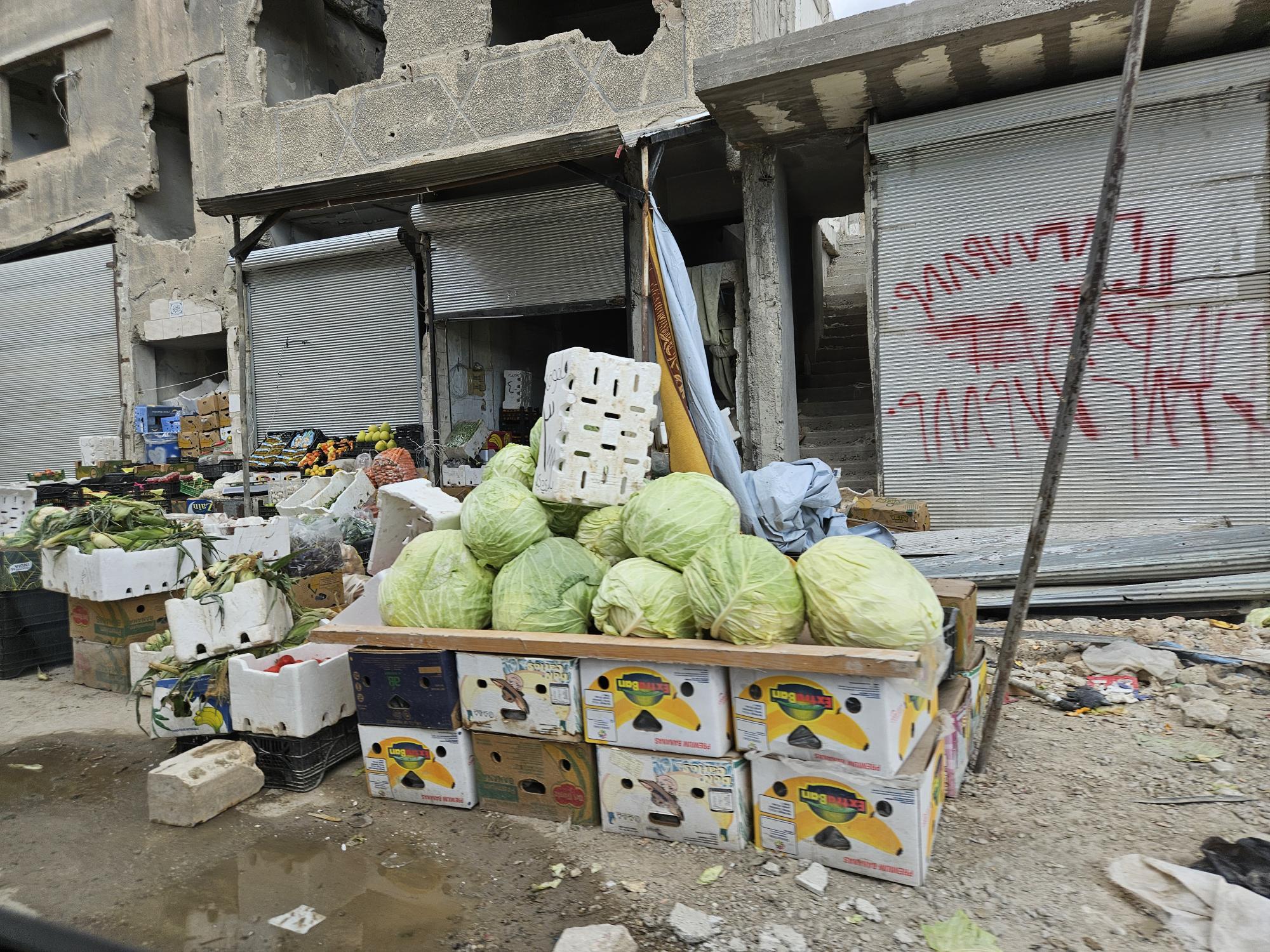
The devastation has seeped into every aspect of life. The economy is devastated, industry is crippled, agricultural lands are scarred and mined, schools and hospitals have been bombed beyond repair, the currency is barely worth the paper it’s printed on. My own family home now stands only on its pillars. My school no longer exists. Friends are scattered, some killed by bombs or torture, others exiled. Every street corner carries a memory and a loss that no “stability index” can measure.
The powerful resistance of the civil society
But what hurts most is the invisible destruction, the erosion of Syria’s social fabric, its sense of community, its shared identity. The violence has changed form but not disappeared. Armed clashes continue along the Alawite coast and in the Druze southeast, while the Kurdish-dominated north remains politically uncertain.
And yet, amid the ruin, Syrians rebuild. Compared to my last visit in December, ghost districts are slowly reclaiming life. Shopkeepers fix shutters, children study under tarps, families share the little water and electricity they have. Without real resources, people persist not out of denial, but out of defiance. This quiet determination is the most powerful resistance left to us.
From Berlin, one might think Syria has suddenly turned into a post-war success story. The contrast is almost comical. While European diplomats and German officials celebrate “progress” and pose for photos with members of the transitional government, the reality on the ground remains harsh.
Transitional processes are rushed; the essential national dialogue process was reduced to the Syrian National Dialogue Conference which served merely as a ceremonial celebration and the consequences are visible in the wave of hate speech and online incitement that followed the recent clashes in Suwayda and along the coast.
Syria awaits a political party law, leaving pluralism uncertain and an establishment of a political scene which is painfully slow. Although civil society has the experience needed to build Syria, it has to fight for its space because it is being sidelined by a new ruling elite eager to consolidate power.
Germany’s return policy
What worries me most is how quickly Syrians are being pushed to the margins of their own story. In international forums and diplomatic statements, the focus is on Syria’s “return to the global stage,” on trade corridors, regional security and diplomatic normalisation, and rarely about the people who carried the revolution’s ideals or paid its price. From the ruins of Damascus, it’s almost surreal to watch how neatly Germany discusses “returns” while ongoing violence in Syria is forcing more people to flee once again.
If Germany truly wanted to support a responsible return policy, it could start by offering Syrians voluntary, temporary return without losing their asylum status. A model built on trust instead of fear, encouraging gradual return instead of turning return into punishment. But instead of grounding their decisions on the reality on the ground, parts of the CDU have chosen debating “mass returns” before ensuring even minimal safety.
Across Europe, governments promise “control” and “returns” to reassure voters, at the expense of legal and moral obligations. Being a Palestinian Syrian and living in Berlin, I see Germany’s migration policy up close, and its double standards are impossible to miss. Officials praise their generosity toward Syrians while quietly shutting the door on others. Palestinians — especially Gazans — who made it to Germany remain trapped in an administrative limbo, facing uncertain legal status or risk of removal.
At the same time, Germany carries on its complicity in the genocide in Gaza. Berlin continues large-scale arms exports to Israel worth over 100 million euros in 2024 and offers unwavering political and diplomatic backing as Gaza is turned to dust. Afghans, fleeing a regime of torture, repression and dehumanisation, are being seen as “security threats”, and deported again though it knows what awaits them upon their return. And Sudanese refugees escaping war find Germany’s gates firmly closed, their asylum claims dismissed even as Germany sells surveillance tools to Sudan’s neighbours. It’s a pattern: compassion when convenient, indifference when costly, lecturing the world on human rights while exporting the means of their violation.
Remembrance culture
To now lecture Syrians to “rebuild their own country like the German Grandfathers and Grandmothers once did,” as CDU politician Jens Spahn suggested, is not only historically wrong, it's morally hollow. Germany was not built only by Germans but also by the hands, sweat, and sacrifice of millions of migrant workers from Italy, Turkey, Greece, and the Balkans. Germany was rebuilt with external power through Marshall Plan billions; the “German economic miracle” rested on immigrant shoulders. Remembrance loses meaning when it becomes selective.
To use the idea of patriotic duty, as Spahn did, to justify deporting people to destruction is a tragic irony. The true lesson of German history is the responsibility to prevent suffering and persecution wherever they occur. A policy that sends Syrians back to rubble, denies Gazans protection, and sidelines Afghans and Sudanese cannot claim moral authority.
What Germany must do to support the transitional process
The Syrians I meet daily are not waiting for Europe to save them. They are already rebuilding their streets, teaching their children, and tending to their wounded cities. What they need is not premature celebration of stability or deportation agreements, but solidarity grounded in human rights and fair asylum procedures. If Germany genuinely wishes to contribute to Syria’s recovery and reconstruction support, it must do so responsibly centring Syrians in the transition process. A transition that reveals the truth, preserves the evidence and ensures this never happens again. If Germany truly wishes to prove that it has learned from its own past, it must act accordingly.
Real remembrance means more than memorials, it means taking responsibility to prevent new cycles of displacement, not just managing them with efficiency. All Syrians, across sects, genders and generations must stand at the centre of this process. Their dignity and their revolution’s unfinished aspiration for freedom, plurality and justice cannot be traded for the illusion of stability.