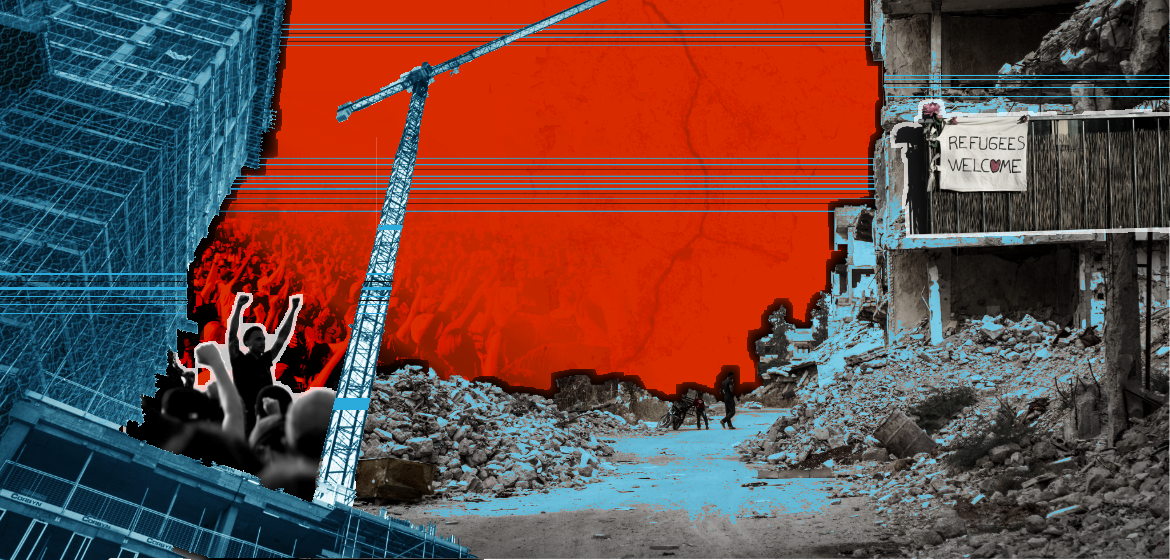
With the end of the war in Syria, a debate began in Germany over the deportation of Syrians. In this dossier, we examine the underlying interests at stake and the possible consequences of return, while highlighting ongoing struggles for freedom of movement. Our aim is to deconstruct populist narratives that too often fuel political agitation rather than foster honest engagement with the realities of migration.
At a time when videos of ICE-raids[1] dominate social media, the claim by German chancellor Friedrich Merz that 80 percent of Syrians should leave Germany over the coming years has struck a raw nerve. At the same time, the pace of shocking headlines has become relentless: the intervals between them are so short that each is quickly swiped off the screen, as we brace ourselves for the next. What lingers is a diffuse sense of fear.
It is precisely this diffuse fear that we seek to confront in this dossier. Merz's proposal is not merely rhetorical. Although neither Merz nor Syria's interim president Ahmed al-Sharaa has ultimately stood firmly behind the statement, and although deportations on such a scale remain legally impossible under current law, developments around the world compel us to ask: what if? The demand for mass deportations is itself a symptom of the growing authoritarian turn in migration policy. Across the European Union, this shift is evident in the implementation of the Common European Asylum System (CEAS) in June 2026 and in the rising numbers of deportations.
Criticism of Merz's proposal has come from many directions. Humanitarian organisations and pro-migrant initiatives rejected it, but so did representatives from business and industry. The latter defended Syrians primarily as indispensable skilled workers, particularly in healthcare and elder care. The fault lines within conflicts over migration therefore do not simply divide supporters of an open society from advocates of racist exclusion. They are also shaped by a tension between recruitment and deportation involving a wide range of actors with competing interests, from small and medium-sized businesses facing labor shortages to trade unions and neighborhood solidarity initiatives.
This dossier explores these contradictions in contemporary migration policy through the lens of Syria and the European border regime. We examine current deportation practices, consider the dystopian prospect of expanding mass deportations under ever weaker legal constraints, and explore strategies of resistance that are already being practiced. But we also ask what a future based on freedom of movement between Syria and Germany could look like.
Our contributors address questions such as: what political calculations and interests lie behind Merz's statement and the public responses it provoked? How do these announcements affect Syrians living in Germany, and how do they themselves think about the question of return? What strategies exist to resist deportations, and what political alternatives to increasingly authoritarian border policies can be imagined?
Our dossier contributions
The dossier opens with an analysis by economist Joseph Daher, who offers an overview of Syria's political economy with particular attention to the self-organisation of workers. He examines how returnees would impact Syria's economy and discusses the prospects of return in relation to employment, housing and reconstruction.
We then turn to the dystopia of deportation. Deportations are already a violent reality for many. They typically take place in the early hours of the morning, targeting refugees in often isolated accommodation centers and attracting little public attention beyond isolated cases. Will these practices become even harsher in the years ahead? How can we resist deportations that are already taking place? Which strategies are being used today, and could neighborhood-based mass mobilisation, like in Minneapolis, also emerge in Germany? Social worker and activist Mel Bennet answers these questions in an interview.
Hussam al-Zaher offers a Syrian-German perspective on the debate. As early as 2015, he called on German society to "Speak with us, not about us!" and founded kohero, a magazine on migration. In his contribution, al-Zaher reflects on the wounds of exile. While some hope these wounds might heal through return, others fear that a new start in Syria would only reopen them. What once felt unfamiliar in Germany has, over time, become home. Syria, by contrast, has in many ways become unfamiliar.
Criticism of increasingly authoritarian border policies is also coming from business groups. They oppose, for example, internal border controls, the deportation of workers and racist discrimination. The economic value of migrant labor comes into direct tension with demands for mass deportations. Fabian Georgi and Dominik Winkler examine why the simultaneous recruitment of migrant workers alongside racist exclusion and deportation is not, in fact, a contradiction. They argue that we may be witnessing a fundamental transformation, and the end of the progressive-neoliberal model of migration management that has dominated recent decades.
Ta-Nehisi Coates wrote that "The cradle of material transformation is in our imagination and our ideas." In his text, Hussein Alhaiba gives shape and colour to a utopian vision of freedom of movement between Syria and Germany. His stories imagine a shared Syrian-German future built on freedom, self-determination and mutual exchange, presenting mobility as an alternative to increasingly militarised borders.
With this dossier, we seek to offer a counterpoint to the growing repression of freedom of movement. Our ambition is not only to criticise the most visible forms of border violence and deportation but also to question more fundamentally the ways borders categorise and divide people. We want to advance the vision of an open migration society beyond a defensive position and make freedom of movement beyond state control imaginable as a political project. In this spirit, we reject the distinction between "useful" and "undesirable" migrants, as well as critiques of deportations grounded solely in humanitarian concern. Instead, we place political agency, ongoing struggles and the utopia of freedom of movement at the center of this dossier. For perhaps it is precisely in this period of authoritarian transformation that spaces are opening for a rising movement resisting exclusion and working collectively toward a world without borders.
[1] ICE refers to the U.S. agency Immigration and Customs Enforcement. The agency drew international attention in early 2026 after images of raids by masked officers targeting undocumented migrants and large-scale protests against these operations circulated around the world.