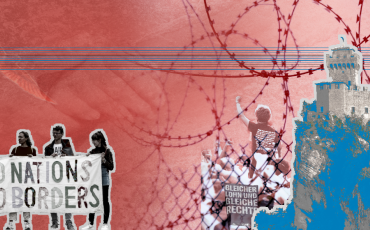

The struggle against deportations in Germany has a long but often hidden history. Despite the repression of freedom of movement, practices of resistance and solidarity continue to challenge the border regime. An interview with Mel Bennet.
The struggle for freedom of movement has faced significant challenges in recent years: growing restrictions on the EU asylum system, the ongoing militarisation of borders and the criminalisation of migration. In this interview, social worker and No Border organiser Mel Bennet [1] talks about strategies for organising resistance and the need to build supportive communities from below.
Who is currently affected by deportations from Germany?
Recently, most deportations from Germany have been to Turkey, with Kurdish people particularly affected. People from "safe" countries of origin in Southeast Europe are also among those most affected. After Turkey, Georgia was the second largest destination country for deportations in 2025. Spain, France, Bulgaria, Greece and Poland are the main destinations for deportations under the Dublin procedure.
There's also been a major rise in deportations to Iraq, following a secretive agreement between Berlin and Baghdad in 2023.
Yes, this disproportionately affects Yezidi people and is a total disgrace. In the same year that Germany recognised the genocide of Yezidis in Iraq, the Federal Office for Migration and Refugees (BAMF) and the administrative courts classified them as no longer facing specific group-based persecution. Asylum approval rates have since plummeted and Yezidis are increasingly being deported into conditions of physical danger, destroyed infrastructure and homelessness.
Despite the Taliban's return to power and a previous deportation freeze, Germany now also conducts regular charter deportations to Afghanistan. People from North African countries like Morocco, Tunisia and Algeria are also deported in high numbers. And in the past two years, the state has increasingly used deportation and migration law as a tool of repression against Palestinians and other activists mobilised against the genocide in Gaza.
In June, the Common European Asylum System (CEAS) reforms came into force. How will this affect deportations?
The reforms are a complete overhaul of asylum law in Germany and the EU. New "border asylum procedures" are already happening at the major airports in Germany. These procedures affect people arriving from countries with asylum approval rates below 20 percent – rates which are already unjust and arbitrary. They also affect people who arrive with missing or invalid documents, which is not uncommon if you are fleeing from difficult situations.
What do these border asylum procedures look like in practice?
The accelerated procedure is limited to twelve weeks, and if the asylum case is rejected, which will be the vast majority, people face another twelve weeks within which they are deported directly from the airport. During this entire time, they are kept in so-called transit facilities: essentially prison-like buildings at airports where they are barred from accessing the outside world and have only highly restricted access, if any, to legal counseling.
All of this happens through the legal fiction of "non-entry": people are not legally considered to have entered German territory, even though they are physically here and incarcerated at the airport. Frankfurt, Berlin and Munich airports are already operating these centres, and more are being planned for Stuttgart, Hamburg and Düsseldorf. This presents a massive challenge for organising and radically changes how people supporting are able to respond to these deportations because of the lack of access.
Beyond this, the rights of people who first arrived in other EU countries and are subject to deportation under the Dublin Regulation are being increasingly restricted. The so-called safe third countries to which people can be deported no longer need to meet the standards for protection set out in the Geneva Convention. All of these CEAS changes erode people's rights and make it easier for the state to deport people.
How are activists organising to block deportations, and how does tightening migration policy affect this work?
In the past, there's been success with mass blockades in front of camps before planned deportations. For instance, in 2014 and 2015, activists in Osnabrück managed to prevent almost 40 deportations through blockades. They mobilised a huge network of people that consistently responded to calls to join the blockades, which physically prevented police access to the camps for deportation arrests. These kinds of interventions require the ability to plan ahead though, as well as political will and solidarity.
With the general tightening of migration policy in the past years, the obligation to provide information about forthcoming deportations has been restricted. Information about when a deportation might happen is vital for organising some kind of response. There are still ways to find out about a planned deportation, for instance through channels like Deportation Alarm, but it is getting more difficult.
Would public blockades still be thinkable today if that information was available?
We are at a very different place now than the "Willkommenskultur" era of 2015. The broader shift to the right within the predominantly white German society, racist narratives about migration and the criminalisation of migration have all contributed to a huge decline in solidarity. This makes it difficult to mobilise large groups of people. Back in 2023 and early 2024, for example, when there was still a chance to prevent the CEAS reforms, demonstrations in Berlin had very low turnout. So we need to plan with this reality and build up capacity to act. If more people were organised and coordinated, so much more would be possible.
How can this point be reached?
I think it's important to use a diversity of tactics in how we respond. To change racist narratives that legitimise deportation, we need to engage with people in our communities and campaign within a wider public. At the same time, we need to continue practically supporting people fighting for their right to stay. This can include sharing resources and connecting people to legal counselling, but also more direct interventions. Ultimately though, the core of the work is to build and strengthen relationships, networks and political structures that will last. The real work is in reducing isolation, being in relationship with our communities and mutually supporting each other.
The massive mobilisation against ICE in the U.S. has gained wide attention. Does it serve as an example for mobilising against deportation in Germany?
The mass mobilisation in places like Minneapolis was effectively centered around neighbourhoods and communities. Autonomous units of people were taking action on their blocks and in their neighbourhoods by watching, patrolling and warning people about ICE, doing food delivery and otherwise supporting each other. The developments there show the potential of building up these kinds of relationships. There are differences between Turtle Island – an Indigenous name for North America including the US – and Germany, but in the end the approach is the same: building up communities of resistance that are aware, connected and ready to take action if people within the community are targeted.
How could this look in Germany?
For political organising, especially within the No Border movement, building relationships with people that might not yet be involved, and people that are stuck in the asylum system, is key. Many groups go to the camps and connect with people there. It is important to create points of contact and access by regularly visiting and sharing information about, for instance, people's rights in the asylum and migration system, or how to access counselling or support structures. We need to build up community and politicised spaces where people can collectively fight for their rights. I am hopeful that we will get there.
For people not yet connected to the struggle against deportations: what are ways to support?
First of all, deportation is framed by states as a legitimate practice of immigration enforcement. This obscures the lived realities of deportation and its inherent violence. The struggle against deportation starts with troubling that normalisation. We need to shift that narrative within our own communities and challenge the way we think about deportation. We cannot mobilise large groups of people to get engaged in a blockade if deportations are considered justified or acceptable in the first place.
People are deported on flights every day from Germany and fellow passengers actually have a lot of power to intervene. People being deported are typically brought to the back of the plane before others are boarded, with or without police. If you see that someone is in this situation, engage with them, ask if they need help. You can refuse to sit down in your seat, voice your opposition to staff and rally other passengers. This can trigger the pilot not to fly with the person onboard due to safety. Pilots have the ultimate authority on whether or not to fly, and it is actually quite common that pilots refuse, either out of ethical principles or liability.
This is just one example, there are a lot of different roles in collectively preventing deportation. Supporting someone early in their asylum or migration process and connecting them to resources can also be decisive. So it's about figuring out how you, whatever your position may be, can be effective.
When Merz announced, during the visit of al-Sharaa, that hundreds of thousands of Syrians in Germany should return to Syria in the coming years, what was your first reaction?
This came as no surprise, unfortunately. Something very similar is already happening with Afghanistan. First they announce they will only deport "criminals" and then they escalate. There are currently five known cases of Afghans without criminal records in detention for deportation, as a direct result of German collaboration with the Taliban and despite severe safety concerns. One of them was already deported.
For imperial nation states like Germany, borders and migration policy serve to maintain white nationalist concepts of citizenship and belonging. Refugees from Syria are not wanted by Germany, unless they fulfill some specific economic function, and the state will take any opportunity to return them. While the contrast of Merz's statement to Merkel's "Wir schaffen das" attitude of the 2015 era might be stark, this is the system working as it has always worked.
Looking back to 2015, don't you think there was some momentum for changing this dominant understanding of citizenship? In a sense, for decolonising the very fundamental understanding of borders and belonging in light of a strengthened post-migrant reality all over Germany?
I take an abolitionist stance on borders. Of course, there are less cruel ways to structure migration. But having grown up in so-called Canada, a settler colonial project, I understand the core of injustice and oppression to be rooted in the state itself and its illegitimate claim to land and sovereignty. Nation states are built on the premise of exclusion – they construct a particular idea of who belongs and who does not. The criteria for belonging is of course colonial, racialised and determined according to capitalist interests. In Germany, notions of citizenship and of being German have always been rooted in white supremacy and the exclusion of "others".
So while there might have been this moment of solidarity in 2015, that goodwill was far from a radical shift in thinking about states, borders and who gets to define who does and does not belong. We can see a decade later how hollow that all was – that there was never a real commitment to people's inherent right to move and to live in dignity and freedom, here or anywhere else.
After the AfD's "remigration" plans were revealed in 2024, millions protested, creating the largest mass demonstration in German history. At the same time, deportations are already happening on a large scale, without widespread protest. How do you explain this?
I think people think of these threats as abstract, as something that could happen in the future. The outrage in 2024 was shortsighted and largely disconnected from the problems and suffering happening already. Of course we need to prevent the AfD from coming to power. But many people overlook the processes of fascistisation that are already taking place. Border violence and deportations are forms of fascist violence. It will get worse and affect even more people if we don't organise effectively against it, but we can look to the repression, the targeting and silencing of activists in the Palestine solidarity movement to see where Germany already stands on principles like freedom of assembly, freedom of opinion and the right to due process.
What are the moments in your political activism that give you hope to continue this work, especially in light of all the violence connected to deportations?
Sharing a political analysis with the people I'm organised with and having clarity in our principles motivates me a lot. Bearing witness to people in their fight to stay and seeing the energy and determination of comrades. Being around other people who are committed to creating a different kind of world and feeling rooted in a collective struggle is hopeful and nourishing.