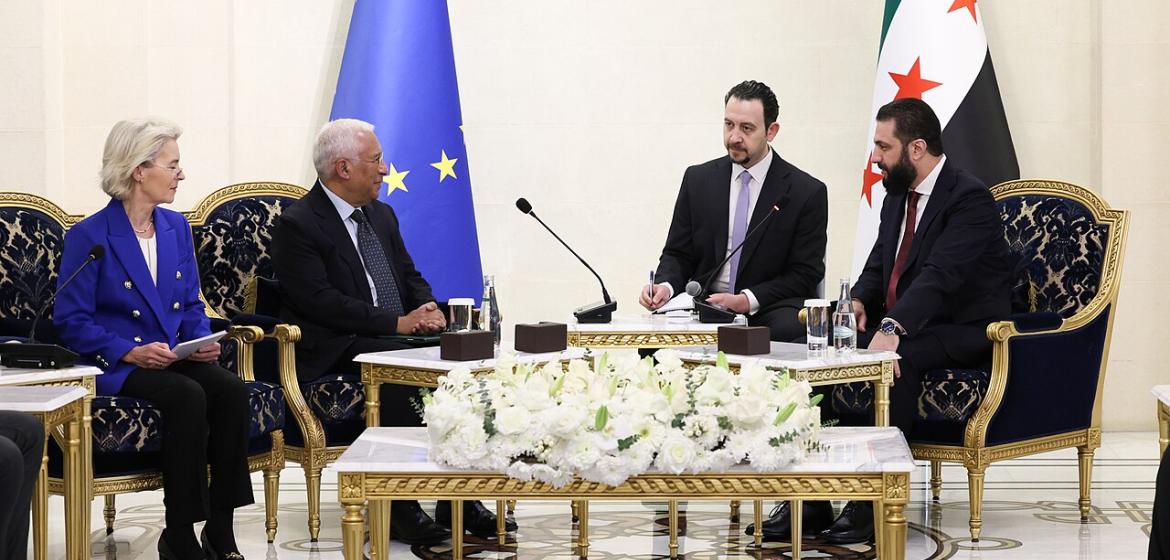
Syria’s interim president Al-Jolani is currently trying to rebrand himself. But what does this mean for LGBTQ+ people in Syria? A closer look at queer life under his reign – from past to present.
During the era of the Islamic Mamluk state, which ruled over Egypt and the Levant from 1250 to 1517, Islamic Sufism spread widely. It viewed same-sex love and cross dressing as a form of worship and a means of drawing closer to God. During the same period, a strict Salafi Islamic doctrine emerged, grounding important parts of its identity in hostility toward same-sex practices and through accusing others of engaging in them. For example, we find the Salafi historian Ibn Al-Jawzi attacking the Islamic Sufi marriage between two men, which he says was very widespread.
The Salafi doctrine remained a minority current with little influence on Islamic societies throughout history. However, after giving rise in the modern era to Al-Qaeda, ISIS, and other organizations, it began to manifest itself in Syria following the Syrian revolution. With the interim government of Al-Julani now in place, it appears to continue its presence.
LGBTQ+ individuals under threat in Iraq: The Al-Qaeda Era
Abu Mohammad Al-Julani, who now goes by his real name Ahmed Al-Sharaa, was born in Saudi Arabia in 1982 and moved to Syria at the age of seven. After studying media for two years, he dropped out of university and traveled to Iraq, where he joined Al-Qaeda in 2003. During this period, Al-Qaeda systematically targeted LGBTQ+ individuals in Iraq. Their rhetoric never shied away from expressing their desire to kill LGBTQ+ people, not just in Muslim-majority countries but globally. In the third issue of Inspire, Al-Qaeda’s official magazine in the Arabian Peninsula, published in November 2010, it was mentioned that a synagogue for LGBTQ+ individuals was supposed to be among the sites targeted in a cargo plane bombing plot. Luckily, the bombs were discovered and the terrorists plan failed.
There are first-hand accounts of homophobic killing campaigns led by extremist groups like Al-Qaeda. In 2009, Human Rights Watch published the report “They Want Us Exterminated”. One of the witnesses in the report––Wahid, a Sunni from Baghdad––recalls how his boyfriend was killed by Al-Qaeda in 2004 during a “general cleansing of people they thought were immoral.” Even minor actions, like barbers threading eyebrows or facial hair, could lead to being targeted in those “cleansing” campaigns. The Al-Qaeda doctrine considered threading hair haram (en.: forbidden) because it was seen as “an imitation of women.” Wahid describes the events: "A group of bearded men surrounded my boyfriend, asked him about the names of his homosexual friends, shot him, and then drove away.” Another witness, Munir, adds that in the wake of those killing campaigns in 2004, two of his gay friends were murdered in areas controlled by Al-Qaeda.
Summoning power in Syria: The Al-Nusra Era
When the Syrian revolution against Bashar Al-Assad began in 2011, Al-Julani went back to Syria, where he established Jabhat Al-Nusra (en.: Al-Nusra front). In 2015, Jabhat Al-Nusra executed nine gay people in rural Homs and Aleppo. According to testimony by a resident to Amnesty International, one execution was particularly horrific – not only because the boy had not yet turned 18: “When I approached the crowd, I saw the body of the boy shot twice. His mother was crying. He looked young. A man standing there told me that he was shot because he was gay. I remembered his case from a year ago, when he was detained by Al-Nusra after he reported that he was sexually assaulted by a group of men. Instead (of helping him) Al-Nusra forces detained him and those he alleged assaulted him.”
Due to such violations, the United Nations Security Council decided to hold a hearing dedicated to LGBTQ+ rights in 2015. Subhi Nahas, a gay refugee from the Syrian city of Idlib, shared his personal experiences with the council. He recalled how the militants of Jabhat Al-Nusra vowed to "cleanse the town of those involved in sodomy" after seizing power in Idlib in 2012. This was followed by arrests and executions of people accused of homosexuality.
An old ideology under a new name? The Post-Liberation Era
In 2016, Al-Julani changed the name of Jabhat Al-Nusra to Hay'at Tahrir Al-Sham (HTS), attempting to distance the organization from its former ties to Al-Qaeda and to reposition it within the Syrian conflict. Over the following eight years, amid shifting alliances and changing regional dynamics, this transformation culminated in his emergence as Syria’s interim president in 2024 after the fall of Al-Assad.
When “The Telegraph” published an article in December 2024 about the relationship between the new Syrian president and LGBTQ+ people, Syrian-Armenian political analyst Kevork Almassian commented sarcastically: “Abu Mohammad Al-Julani has been described so far as a 'rebel,' 'diversity-friendly,' and 'progressive.' Soon, will he be the leader of LGBTQ+ allied forces?” Nevertheless, a lot of Western governments celebrated Al-Julani, lifted economic sanctions against him, removed him from terrorist lists, and began planning his normalization with Israel.
Meanwhile, an article by the Media Diversity Institute published mid-2025 calls Al-Jolanis policies a “crackdown” on the LGBTQ+ people in Syria. A video leaked at the beginning of last year shows a glaring example: A young Syrian transwoman sits in the back of a police car, sided by two police men. One of them is wearing a uniform with the emblem of Jabhat Al-Nusra. The police men are insulting her and cutting her with a knife, while demanding her to show her genitals and threatening to “cut it off.”
Responding to such threats, the Syrian Guardians of Equality movement issued a safety guide for LGBTQ+ individuals. One of the instructions reads: “delete any information that could reveal your sexual or gender identity in case of raids or inspections at homes or security checkpoints.” The guide also advises “visible individuals” to move out of areas that may be controlled by these groups.
The Future: An Era of Insecurity
Talking to a queer Syrian activist who moves between Syria and Europe and wants to remain anonymous for safety reasons, they told me: “not only queers—violence is being committed against Alawites, Druze, and Kurds in Syria by the new security forces. They are trying to impose their control over public spaces through violence against all minorities.” This becomes clear in recent footage of security officers forcibly shaving off the mustache of a Druze elder to humiliate him, and the cut-off ponytail of a Kurdish female fighter.
Public executions, arrests, humiliation, and the use of accusations of “immorality” function not only as punishment but as a tool for governance through fear. Recent reports and leaked footage suggest that, despite Al-Jolanis attempts of rebranding, elements of this coercive moral policing persist. At the same time, the broader pattern of violence against minorities indicates that repression is not limited to sexuality alone. Rather, it reflects an ongoing struggle over identity, sovereignty, and social control in post-Assad Syria.